 (516) 679-2225



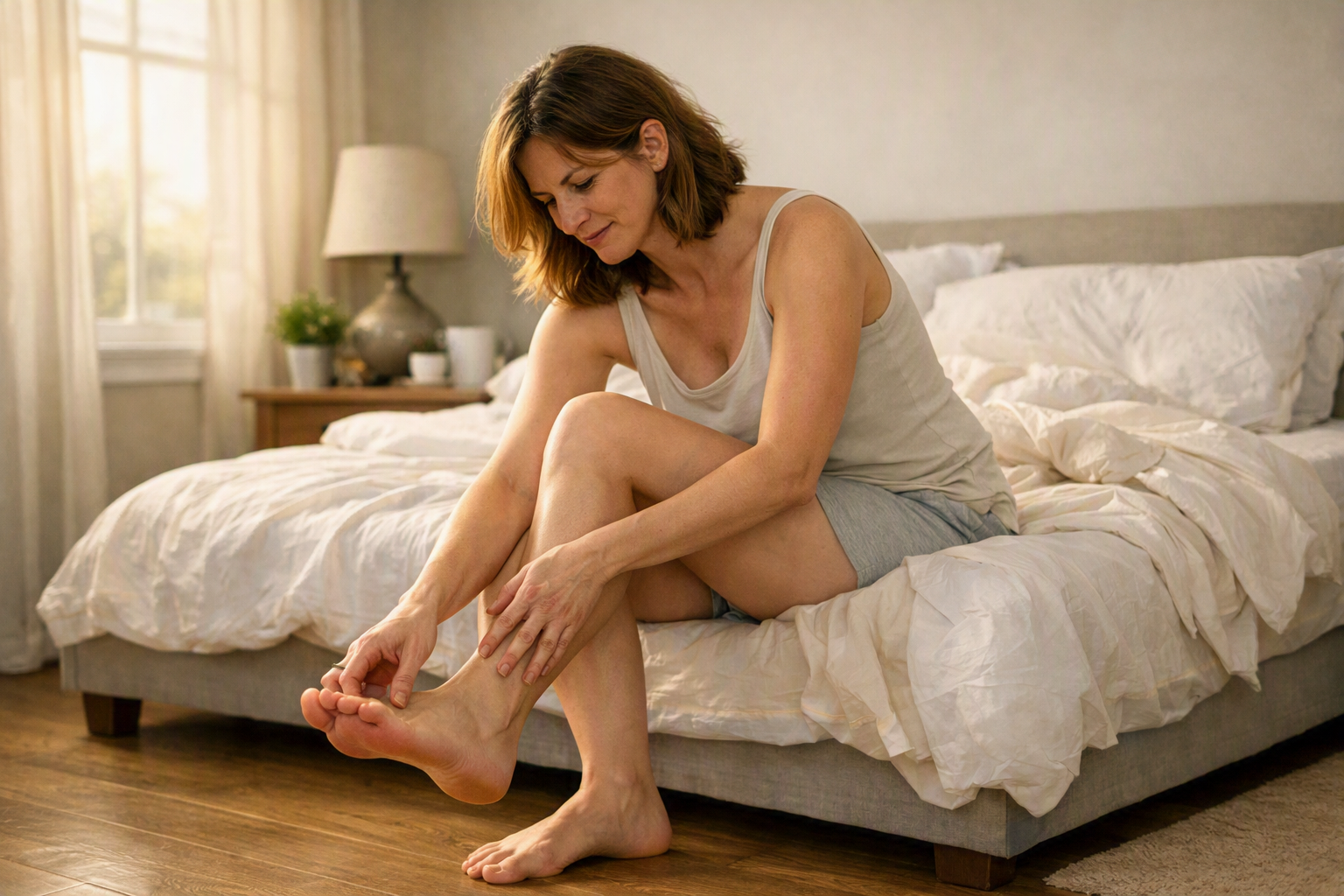
You swing your legs out of bed, put your first foot down, and a sharp pain drives up through your heel. By the time the coffee is made it has softened to a dull ache, and by mid-morning you have nearly forgotten it. Then you spend an afternoon on the boardwalk or standing barefoot on the sand, and that night it comes back with interest. If that pattern sounds familiar, you are describing one of the most recognizable presentations of plantar fasciitis we see at our Bellmore office, and summer on Long Island is the season when it tends to announce itself.
Heel pain of this kind is stubborn for a straightforward reason: the tissue involved never really gets to rest, because every step you take loads it again. That is also why so many people cycle through new sneakers, drugstore inserts, and calf stretches for months without much to show for it. The Graston Technique®, an instrument-assisted soft tissue approach Dr. Marmorale has been certified in since 2008, works on a different part of the problem, namely the fascial restriction and scar tissue that accumulates in chronically overloaded tissue. If you have read our earlier post on whether the Graston Technique works on tarsal tunnel syndrome, you already have a feel for how instrument work applies to the foot. Heel pain follows a similar logic.
Table of Contents
What Is Plantar Fasciitis, and Why Does It Flare Up During Summer Activity?
The plantar fascia is a thick band of fibrous connective tissue that runs along the bottom of your foot, from the heel bone forward to the base of the toes. Its job is to support the arch and act something like a bowstring, storing and releasing energy as you walk. When that band is repeatedly overloaded, small tears develop in the fibers, most often right where the fascia attaches to the heel. The result is plantar heel pain concentrated in a spot roughly the size of a quarter on the underside of the heel.
It is common enough that most people know someone who has dealt with it. Research suggests roughly one in ten people will develop plantar fasciitis at some point, and it accounts for a substantial share of foot complaints brought to clinicians each year. It is not exclusively an athlete’s condition either. Runners get it, but so do teachers, nurses, retail workers, and anyone whose day involves long stretches of standing.
Summer is when we see the sharpest uptick, and the reasons are mostly behavioral rather than mysterious. Activity levels jump quickly after a quieter winter. Walking mileage goes up. People spend more time barefoot on decks, in the house, and on the beach, and more time in flip-flops and slides that offer little arch support or shock absorption. Sand is a particularly demanding surface because it shifts underfoot, forcing the arch to work harder to stabilize every step. Add a sudden increase in volume to a tissue that spent months underused, and the fascia takes on more load than it has adapted to handle.
Plantar Fasciitis or Plantar Fasciosis? What Is Actually Happening to the Tissue
The name plantar fasciitis implies inflammation, since the suffix “itis” means exactly that. The clinical picture is usually more complicated. When researchers have examined tissue samples from chronic cases, they have generally found degeneration of the collagen fibers rather than active inflammation, which is why many clinicians now prefer the term plantar fasciosis. In practical terms, the fascia has not simply become irritated. It has begun to break down and repair itself poorly.
That distinction matters because it changes what treatment needs to accomplish. If the problem were purely inflammatory, calming the inflammation would resolve it. Because the problem is largely one of disorganized tissue repair, the tissue itself needs to be remodeled. Repeated cycles of microtearing and incomplete healing tend to lay down scar tissue and adhesions that are stiffer and less elastic than healthy fascia. That stiffer tissue tolerates load poorly, which sets up the next round of tearing. Breaking that cycle is the reason instrument-assisted work is often useful where rest alone has stalled.
Why Heel Pain Is Sharpest With Your First Steps in the Morning
The morning symptom is so characteristic that it often makes the diagnosis on its own. While you sleep, your foot rests in a relaxed, slightly pointed position and the plantar fascia shortens. Overnight, the body also begins knitting together the microtears from the previous day, but it does so with the tissue in that shortened state. When you stand up and put full body weight on the foot, the fascia is abruptly stretched and those overnight repairs are pulled apart again, which produces that unmistakable stabbing sensation.
The same mechanism explains why the pain often eases after a few minutes of walking, then returns after you have been sitting at a desk or in the car for a while. It also explains why the ache tends to be worse at the end of a long day on your feet than at the start. If your heel hurts most with the first steps after rest, and again after prolonged standing, that pattern points fairly reliably toward the plantar fascia rather than a nerve or joint problem. Persistent numbness, burning, or tingling into the sole suggests something different is going on and deserves a separate evaluation.
Plantar Fasciitis vs. Heel Spur: Does the Difference Change Treatment?
Many people arrive at our office with an X-ray showing a heel spur and the understandable assumption that the spur is the source of the pain. A heel spur is a small calcium deposit that forms on the underside of the heel bone, usually in response to long-term traction from the plantar fascia at its attachment point. In other words, the spur is more often a consequence of chronic fascial strain than its cause.
The clinically useful point is that many people with heel spurs have no pain at all, and plenty of people with significant plantar heel pain have no spur on imaging. For that reason, the presence of a spur rarely changes the conservative treatment plan. The target is the same either way: restore the health and flexibility of the fascia, address the mechanical factors loading it, and reduce the traction at the attachment. Surgical removal of a spur is uncommon and generally considered only after an extended course of conservative care has failed.
How the Graston Technique® Addresses Plantar Fasciitis Differently From Stretching or Orthotics
The Graston Technique® is a form of instrument-assisted soft tissue mobilization, usually shortened to IASTM. Dr. Marmorale uses a set of contoured stainless steel instruments that glide across the skin over the affected area. Because the instruments transmit vibration from the tissue underneath to the clinician’s hands, they make it possible to detect soft tissue irregularities more easily than with hands alone. That diagnostic function is genuinely useful in the foot, where restrictions frequently sit not only in the plantar fascia itself but in the calf, the Achilles tendon, and the small intrinsic muscles of the arch.
Once a restricted area is identified, treatment involves short, repeated strokes over the tissue. The working theory is that the controlled pressure creates a small, localized microtrauma that reintroduces a healing response to tissue that has stalled in a chronic, poorly repaired state, encouraging the breakdown of restrictive adhesions and healthier collagen alignment as the area remodels. This is the meaningful difference from stretching or orthotics. Stretching lengthens tissue and orthotics redistribute load, and both are valuable, but neither directly addresses the scar tissue and adhesions that have already formed. Soft tissue mobilization works on that existing tissue.
There is also supportive clinical evidence specific to this condition. A randomized trial published in 2022 found that adding Graston Technique to conventional treatment produced significantly greater pain reduction at both the two-week and four-week marks compared with conventional treatment alone. That framing is worth holding onto. Graston work is not positioned as a replacement for stretching, footwear changes, or loading exercise. It performs best as an addition to them. Results still vary by individual, and no responsible clinician will tell you that instrument work cures plantar fasciitis.
Combining Graston Technique® With Chiropractic Adjustments
Heel pain rarely exists in isolation. When one foot hurts, you unconsciously shift weight away from it, and that altered gait travels up the chain into the ankle, knee, hip, and low back. Restricted motion in the ankle or subtalar joint, or a pelvic imbalance that changes how you load one side, can keep feeding strain into the fascia no matter how well the local tissue is treated.
Combining instrument work with chiropractic adjustments lets Dr. Marmorale address both layers, treating the damaged tissue while also correcting the joint mechanics that overloaded it. For patients whose heel pain has already changed how they walk, this combined approach is often the more durable path. You can read more about how the practice approaches foot and ankle pain across a range of conditions.
What a Graston Technique® Session on the Foot and Heel Feels Like
Most patients want to know what they are in for before the first appointment, which is a fair question. A session on the foot begins with the instrument gliding over the heel, arch, and calf so Dr. Marmorale can locate areas of restriction. Once he finds them, treatment consists of focused strokes over those spots, typically for several minutes per area. Patients usually describe the sensation as an intense, targeted pressure or a firm scraping feeling rather than sharp pain. It should be tolerable, and treatment pressure is adjusted based on your feedback throughout. Anyone who tells you the technique is completely painless is overselling it.
Some redness or mild bruising in the treated area afterward is a fairly common and generally expected response to initial treatment, reflecting increased blood flow to the area rather than tissue injury. Sessions are commonly paired with stretching, a home loading program, and sometimes ice, since the tissue tends to respond better when instrument work is followed by movement that guides the remodeling tissue along useful lines.
How Many Sessions Before You Notice Improvement in Heel Pain?
The honest answer depends on how long you have had the pain and how much restriction has developed. A heel that started bothering you three weeks ago behaves very differently from one you have been managing for two years. Many patients report noticing some change within the first few visits, with more substantial improvement building over several weeks of consistent treatment. Dr. Marmorale will reassess as you go and adjust the plan rather than commit you to a fixed number of visits up front.
It also helps to have a realistic sense of the overall timeline. Plantar fasciitis is a condition that responds well to conservative care, but not quickly. Studies of nonsurgical management have found that the large majority of cases resolve within six to eighteen months of consistent treatment. Adding soft tissue mobilization is aimed at shortening that window and reducing pain along the way, not at bypassing it. Patients who stay consistent with home care between visits generally progress faster than those who rely on in-office treatment alone.
Who Should Not Receive Graston Treatment on the Foot?
Graston Technique® is not appropriate for everyone, and part of the initial evaluation is confirming that you are a suitable candidate. Instrument work is avoided over open wounds, active skin infections, or unhealed fractures, and it is not used in the presence of a known blood clot. Patients on blood thinners or with bleeding disorders, uncontrolled high blood pressure, active cancer in the region, or certain circulatory conditions may need a modified approach or a different treatment entirely. Diabetic patients with reduced sensation in the feet warrant particular care, since diminished feedback makes it harder to gauge tolerance. This is exactly why the technique belongs in the hands of a certified clinician rather than an at-home tool.
What You Can Do at Home Between Graston Sessions
What you do between appointments has a real effect on how quickly heel pain settles. The tissue is remodeling in the days after each session, and how you load it during that window matters. A few habits carry most of the benefit:
- Stretch the calf and plantar fascia before your first steps in the morning, while still seated, rather than standing up cold
- Wear supportive footwear indoors as well as out, and take a break from flat sandals and going barefoot on hard floors during a flare
- Roll the arch over a frozen water bottle or a firm ball for several minutes at the end of the day
- Add slow, controlled calf raises to build load tolerance in the tissue, progressing gradually rather than pushing through pain
Managing total volume matters just as much as any single exercise. If a long beach walk reliably leaves your heel angry the next morning, that is useful information rather than something to push through. Scaling back temporarily and rebuilding gradually tends to work better than alternating between overdoing it and resting completely. And if your heel pain has persisted beyond a few weeks despite better footwear and consistent stretching, that is a reasonable point to have it evaluated rather than waiting to see whether another month changes anything.
Don’t Let Plantar Fasciitis Keep You Sidelined
At East Bay Chiropractic Wellness P.C. in Bellmore, we have spent more than 35 years helping people across Nassau County get out of pain without surgery or long-term medication. As one of the only Certified Graston Technique® Specialists on Long Island, credentialed since 2008, Dr. Martin Marmorale, DC, has treated plantar heel pain in runners, walkers, and people who simply spend all day on their feet, and he will tell you honestly whether instrument-assisted work is the right fit for your foot.
If that first step out of bed has been the worst part of your morning for weeks, you do not have to keep planning your summer around it. Schedule a consultation and let us take a look at what is actually happening in that heel.
If this was useful, tell Google you want more of it.


Leave a Reply