 (516) 679-2225



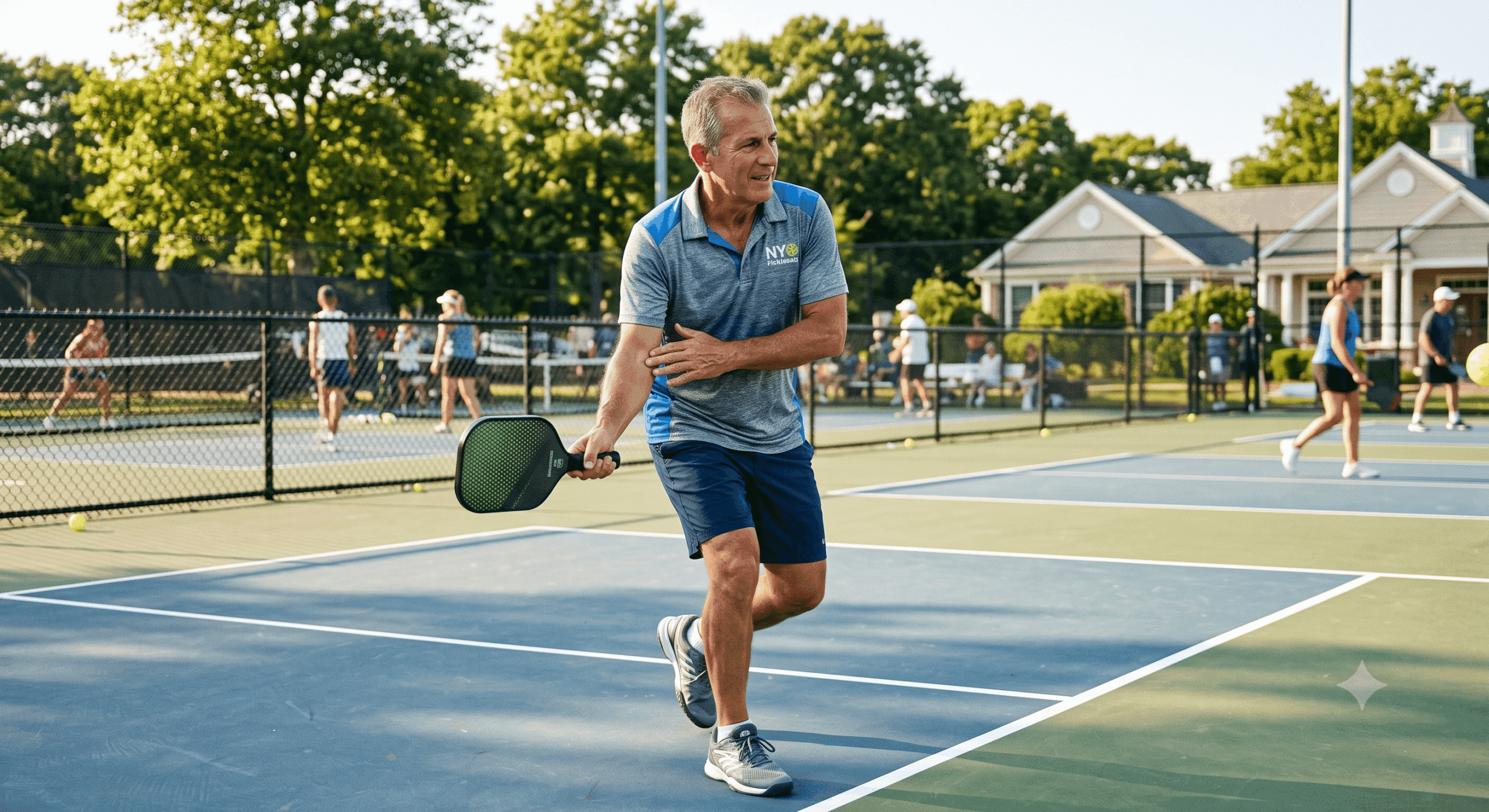
Your elbow has been aching for two weeks, and it is not settling down between games. Or maybe it is your heel, sharp and stubborn every time you step out of bed in the morning. If pickleball has become part of your weekly routine here on Long Island, you are far from alone in dealing with an ache that showed up around the same time you picked up a paddle.
Pickleball’s reputation as a gentle, low-impact sport can be misleading. The quick lateral cuts, sudden stops, and repetitive paddle strokes place real demand on tendons and connective tissue that many players have not used this way in years. We see this pattern often in the elbow injuries that show up across racket and paddle sports, and pickleball has become one of the more common causes of it at our Bellmore office. The encouraging part is that these soft tissue injuries tend to respond well to targeted, hands-on treatment, including the Graston Technique®, an approach Dr. Marmorale has used with active adults on Long Island for years.
Table of Contents
Why Pickleball Puts So Much Stress on Your Joints and Soft Tissue
Pickleball is often marketed as easier on the body than tennis or running, and in some ways it is. The court is smaller, the ball travels slower, and total distance covered per game is lower. What that reputation leaves out is direction change. Pickleball rallies are built around short, explosive movements: a lunge toward the kitchen line, a quick pivot to cover a lob, a hard stop right before contact. And with a higher number of older participants, the sport can be more demanding on the body than one would first assume.
Those abrupt lateral demands land on tendons, ligaments, and fascia that were not conditioned for this kind of movement, particularly in players who spent years in lower-impact activity before taking up the sport. Injuries we most often see in pickleball players include:
- Lateral epicondylitis, commonly called pickleball elbow or tennis elbow
- Achilles tendon strain or tendinopathy
- Rotator cuff strain from overhead serves and smashes
- Plantar fasciitis and ankle sprains from quick pivots and lateral cuts
Because these injuries tend to build gradually rather than arrive from one dramatic fall, many players wait weeks before addressing them. That delay often allows scar tissue and fascial restrictions to form around the injured area, which is part of why the discomfort can linger long after a game ends.
Pickleball Elbow: Is It the Same as Tennis Elbow?
Pickleball elbow and tennis elbow are usually the same underlying condition: lateral epicondylitis, an irritation of the tendons that attach to the bony bump on the outside of the elbow. The tendon becomes inflamed and, over time, can develop small areas of degeneration from repeated strain rather than a single injury.
What differs is the mechanism. Tennis players tend to develop it from the backhand stroke, while pickleball players more often develop it from the paddle’s lighter weight combined with a stiff-wristed grip during quick volleys and dinks at the net. The repetitive, small-amplitude motion of dinking can load the tendon just as much as a full swing, which is one reason pickleball elbow has become so common even among players who never had elbow trouble in other sports.
Achilles Tendon, Ankle, and Lower-Body Injuries in Pickleball
The lower body absorbs its own share of stress in pickleball. The Achilles tendon, which connects the calf muscles to the heel bone, is repeatedly loaded every time a player pushes off for a lunge or a quick sprint to the net. Over weeks or months, that repetitive loading can lead to Achilles tendinopathy, a gradual breakdown and thickening of the tendon that causes stiffness and pain, especially first thing in the morning.
Ankle sprains are common for a different reason. Pickleball’s rapid side-to-side movement and frequent direction changes put the ankle in vulnerable positions, particularly when a player is fatigued late in a match and reaction time slows. Foot and heel pain, including plantar fasciitis, tends to show up in players who increase their court time quickly without building up gradually.
How the Graston Technique® Treats Soft Tissue Injuries From Pickleball
The Graston Technique® is a form of instrument-assisted soft tissue mobilization, often shortened to IASTM. Dr. Marmorale uses a set of specially contoured stainless steel instruments to glide across the skin above the injured area, which helps locate areas of fascial restriction and scar tissue that are difficult to detect and treat by hand alone.
The controlled pressure from the instruments is thought to create a small, localized microtrauma that prompts the body’s natural healing response, encouraging the breakdown of restrictive scar tissue and supporting healthier collagen fiber alignment as the area remodels. In plain terms, it is designed to help tissue that has become sticky or fibrous move and heal the way it should.
This approach tends to work well for the chronic, overuse soft tissue injuries that pickleball produces, including pickleball elbow, Achilles tendinopathy, plantar fasciitis, and rotator cuff strain. As part of a broader sports injury treatment plan, Graston work is often paired with chiropractic adjustments and a home stretching routine. Dr. Marmorale is one of Long Island’s only Certified Graston Technique Specialists, a credential he has held since 2008, which means the treatment reflects a level of specialized training beyond general soft tissue work.
Graston Technique® vs. Deep Tissue Massage: What Is the Difference?
Both approaches work on soft tissue, but the tools and the goals differ. Deep tissue massage uses sustained hand pressure to relax muscle tension and improve general circulation. Graston Technique® uses instruments specifically to detect and treat fascial restrictions and adhesions that hands often cannot feel through layers of muscle.
Patients sometimes describe Graston as feeling more clinical and targeted, while massage feels more broadly relaxing. Many patients benefit from both, using massage for general muscle recovery between pickleball sessions and Graston for the specific, stubborn areas of scar tissue or restriction that are not resolving on their own.
What to Expect During a Graston Technique® Session
A typical session begins with the instrument gliding over the skin to help Dr. Marmorale identify areas of restriction. Once an area is located, treatment involves short, repeated strokes over the tissue. Most patients describe the sensation as an intense pressure or a mild scraping feeling rather than sharp pain, though tender areas can feel uncomfortable in the moment.
Mild bruising or redness after a session is a fairly common and generally expected response, since it reflects increased blood flow to the treated area rather than tissue damage. As with any treatment, results and recovery time vary by individual, and Dr. Marmorale will walk you through what a normal response looks like for your specific injury.
Can You Keep Playing Pickleball During Treatment?
In many cases, patients can continue playing at a modified level while receiving Graston treatment, particularly if the injury is caught early. Dr. Marmorale will typically recommend adjusting frequency or intensity, and in some cases pausing play briefly, depending on how irritated the tissue is and how the injury is responding to care.
How Many Sessions Before You Notice Improvement?
The number of sessions needed depends on how long the injury has been present and how much scar tissue or fascial restriction has developed. Many patients report noticing some improvement within the first few visits, with full recovery often building over several weeks of consistent treatment. Because every case is different, results vary by individual, and a personalized treatment timeline is something Dr. Marmorale sets during your initial evaluation.
Warm-Up and Injury Prevention Tips for Pickleball Players
A short, targeted warm-up before stepping onto the court can meaningfully lower your risk of the soft tissue injuries described above. Consider building these steps into your pre-game routine:
- Five to ten minutes of light cardio, such as brisk walking or jogging in place, to raise tissue temperature
- Dynamic stretches for the wrist, forearm, and shoulder, such as wrist circles and arm swings
- Lateral lunges and side shuffles to prepare the hips and ankles for quick direction changes
- A gradual progression into dinking and volleys before full-speed rallies
If an ache or stiffness persists for more than a week despite rest and a proper warm-up routine, it is a reasonable point to have it evaluated rather than waiting for it to resolve on its own.
Don’t Let Injury Keep You From The Game Longer Than It Should
At East Bay Chiropractic Wellness P.C. in Bellmore, we have spent over 35 years helping active adults across Nassau County get back to the activities they love, and pickleball is no exception. As one of the only Certified Graston Technique Specialists on Long Island, Dr. Martin Marmorale, DC, has the specialized training to identify exactly which soft tissue is driving your pain and to build a treatment plan around it, whether that is pickleball elbow, an aching Achilles, or a heel that will not calm down.
If pickleball has left you nursing an injury that is not improving on its own, schedule a consultation with our Bellmore office today and let’s get you back on the court.
If this was useful, tell Google you want more of it.


Leave a Reply