 (516) 679-2225



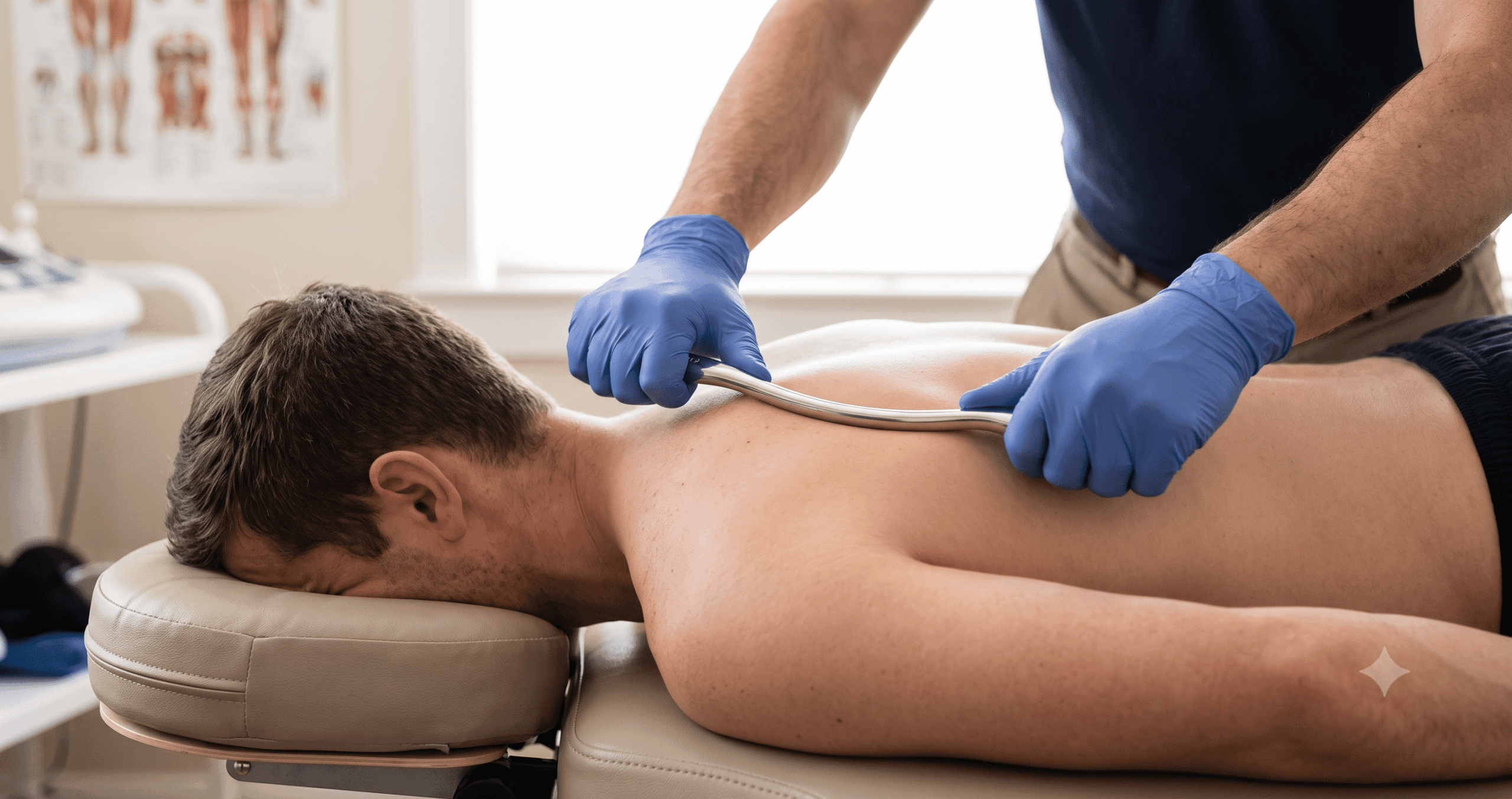
You can usually find them with your fingertips — those small, tender, rope-like spots buried in the muscles of your upper traps, your lower back, or the side of your hip. You press, and they push back. You stretch, and they refuse to soften. Sometimes they radiate a dull ache far from where you are pressing, leaving you wondering why your shoulder hurts when the source of the trouble seems to be somewhere else entirely. These stubborn pockets of restricted tissue are commonly called muscle knots, and they are one of the most frequent — and most frustrating — reasons patients walk into our office.
Muscle knots feel deceptively simple to fix. Roll them out, press them harder, stretch them more — surely something will give. But anyone who has lived with a recurring knot in the shoulder or low back knows the truth: most of these tight spots simply do not respond to general stretching or self-massage in the long term. The reason has less to do with the muscle itself and more to do with the layers of connective tissue surrounding it. If you have already read about how stubborn restrictions interact with muscle tightness when returning to exercise, this article picks up where that one left off and focuses specifically on what to do when a knot will not let go.
Table of Contents
What Is a Muscle Knot?
A muscle knot — known in clinical literature as a myofascial trigger point — is a small, hyperirritable nodule located within a tight band of skeletal muscle fibers. When you press on one, it feels firm or rope-like under the skin, and it often produces local tenderness as well as referred pain, discomfort felt in a different area of the body altogether. Myofascial trigger points are found in up to 85% of patients with chronic musculoskeletal pain, making them one of the most common drivers of chronic neck, shoulder, and back complaints.
What makes a trigger point different from generalized soreness is its persistence. Soreness from a workout fades within days. A knot can linger for weeks, months, or even years, often flaring up under stress, prolonged sitting, or repetitive use. The tissue surrounding the trigger point gradually develops a kind of restriction — an adhesion within the fascia, the thin connective tissue sheath that surrounds and threads through every muscle in your body. Over time, that restriction interferes with the way the muscle slides, contracts, and releases.
Why Do Muscle Knots Form?
Muscle knots rarely have a single cause. They are the body’s response to repeated mechanical or chemical stress — a kind of localized protective reflex that, when held too long, becomes part of the problem. Common contributors include:
- Postural strain. Hours spent at a desk, behind a steering wheel, or hunched over a phone keep the upper traps, levator scapulae, and rhomboids in a shortened, contracted position.
- Repetitive motion. Painters, hairstylists, dental hygienists, and athletes who perform the same movement thousands of times often develop knots in the muscles doing the work.
- Old injuries. A neck strain from years ago, a fall, or even a fender bender can leave behind areas of fibrotic scar tissue inside muscle and fascia that contract and tighten under load.
- Stress and shallow breathing. Emotional tension activates the sympathetic nervous system, which raises baseline muscle tone, particularly in the jaw, neck, and shoulders.
- Dehydration and nutrient depletion. Muscle tissue requires water, magnesium, and electrolytes to contract and relax efficiently. Chronic depletion makes fibers more prone to sticking in a contracted state.
Once a knot forms, the tissue inside loses access to normal circulation. Oxygen delivery drops, metabolic byproducts accumulate, and the local nerves become sensitized — which is why a quiet trigger point can suddenly start screaming when you finally press on it.
What Is Happening Inside a Muscle Knot?
When you feel a knot, you are not feeling the entire muscle in spasm. You are feeling a localized taut band — a small bundle of muscle fibers stuck in a contracted state. Within that band sits the trigger point itself, where research suggests sustained acetylcholine release at the motor endplate keeps the area in involuntary contraction. The contraction compresses local capillaries, starves the area of oxygen, and creates a chemical environment that further sensitizes pain receptors.
This is why pressing on a knot often feels disproportionately intense, and why the surrounding fascia begins to thicken and adhere. The longer the knot persists, the more fibrotic the surrounding tissue becomes, and the harder it is to release through stretching alone. This is the concept of soft tissue adhesion — fascia and muscle layers that should glide independently begin to stick together, restricting movement and perpetuating the cycle of tightness.
Why Stretching and Foam Rolling Often Do Not Fix the Problem
Stretching feels intuitive. If a muscle is tight, lengthen it. But trigger points and adhesions do not respond to lengthening the way healthy tissue does. Stretch a muscle that contains a taut band, and the healthy fibers around the knot lengthen first — leaving the knot itself largely unchanged. The relief feels temporary because the underlying restriction has not been addressed.
Foam rolling and massage gun work can offer short-term symptomatic relief by stimulating circulation and briefly downregulating muscle tone. But for entrenched soft tissue adhesion, those tools are usually too broad and too imprecise to remodel the actual restricted tissue. Patients often arrive at our office having spent months chasing relief with home tools, only to find that the knot itself has not actually changed.
That is where instrument-assisted manual therapy comes in.
How Does the Graston Technique® Break Up Muscle Knots?
The Graston Technique® is an evidence-informed form of instrument-assisted soft tissue mobilization (IASTM) that uses a set of patented stainless steel instruments designed to detect and treat areas of fascial restriction, scar tissue, and chronic muscle adhesion. Each instrument has a unique curve and edge that allows the clinician to follow the contours of the body — from the broad surface of the upper back to the narrow space between forearm muscles.
When a trained clinician glides a Graston Technique® instrument over the affected area, two things happen at once. First, the instrument acts as a kind of diagnostic amplifier: subtle restrictions that would be missed with fingers alone become palpable through the steel. The patient typically feels a distinctive grainy or gritty sensation as the tool passes over a knot. Second, the controlled mechanical pressure produces a precise micro-stimulus to the restricted tissue, triggering a brief, localized inflammatory response. That response signals the body to remodel the area — clearing adhered fibers and depositing new, properly aligned collagen in their place.
In simpler terms, the Graston technique for muscle knots does not “smash” or “break” the knot in any aggressive sense. It signals the tissue to release its grip and rebuild itself in a more functional pattern. Patients often describe the sensation afterward as the muscle finally “letting go” — a quality of release that stretching and self-massage rarely produce.
Myofascial Release vs. Graston Technique®: Are They the Same?
Patients frequently ask whether the Graston Technique® is just another form of myofascial release. The two share a common goal — restoring normal glide and elasticity to fascia and muscle — but they differ in execution. Traditional myofascial release relies on the clinician’s hands to apply sustained, low-load pressure across restricted tissue, gradually encouraging it to lengthen. It is gentle, broad, and well-suited to large fascial restrictions.
The Graston Technique® takes a more targeted approach. Because the instruments transmit far more precise feedback than fingertips alone, a clinician can isolate a single rope-like adhesion or trigger point and treat it directly. For deep, fibrotic, or long-standing knots — the kind that have shrugged off years of massage — that precision often makes the difference between symptomatic relief and lasting change. Clinical studies of IASTM have reported improvements in pain and range of motion for chronic soft tissue conditions, supporting its use as part of an integrated manual therapy plan rather than a stand-alone fix. In our practice, we often layer the two approaches depending on what the tissue requires.
Chiropractic Care for Muscle Knots
Treating the knot itself is only half the picture. Chiropractic care for muscle knots addresses the underlying biomechanics that allowed the knot to form in the first place. When a joint is not moving correctly — a stiff midback segment, a restricted hip, a fixated cervical vertebra — the muscles around that joint pick up the slack. They contract harder, fatigue faster, and become fertile ground for trigger points.
By restoring proper joint mobility through targeted chiropractic adjustment, the surrounding musculature is asked to do less compensatory work. Combined with the Graston Technique® and individualized exercise guidance, this approach treats both the knot and the reason it kept coming back. Many of our patients with chronic shoulder, neck, or low back knots have spent years cycling between massage and self-care without lasting results — until the joint pattern driving the muscle dysfunction is finally identified and treated. You can read more about our approach on our Graston Technique® therapy page.
What to Expect During a Graston Technique® Session
A typical Graston Technique® treatment begins with a brief assessment. The clinician identifies the affected area, palpates the surrounding tissue, and applies a small amount of emollient to allow the instruments to glide smoothly. The active portion of treatment usually lasts only a few minutes per region — sustained, slow strokes along the line of muscle fibers and across known areas of restriction.
You may feel a brief, sharp sensation as the instrument passes over a particularly stubborn adhesion. Most patients describe this as “uncomfortable but productive.” After treatment, the area is typically warm and slightly pink as blood flow returns to previously restricted tissue. Some mild bruising or tenderness over the following 24 to 48 hours is normal and reflects the controlled inflammatory response that drives tissue remodeling — the very mechanism that allows the knot to release.
Active recovery is encouraged in the hours after a session: gentle movement, hydration, and prescribed stretches help reinforce the new tissue patterns. Most patients notice meaningful improvement within two to four sessions, though longstanding knots may require a longer course of treatment.
When to See a Chiropractor for a Muscle Knot
Not every knot needs professional treatment. A mild knot from an unusual workout, a poor night’s sleep, or a long drive will often resolve with rest, hydration, and gentle movement. Consider scheduling an evaluation when:
- A specific knot has lasted more than two weeks despite stretching, foam rolling, or self-massage.
- You feel referred pain from a knot — for example, a low-back knot that sends discomfort down the leg, or an upper-trap knot that produces headaches.
- The same knot keeps returning in the same place, even after temporary relief from massage or self-care.
- Range of motion in a nearby joint feels limited or “stuck.”
- The discomfort is interfering with sleep, work, or an activity you used to do without thinking.
A focused evaluation can distinguish between a typical trigger point, a deeper soft tissue adhesion, joint dysfunction wearing a muscle mask, and something requiring imaging or referral. The earlier those distinctions are made, the faster you stop chasing relief and start producing real change.
Release the Knot, Restore the Movement — at East Bay Chiropractic Wellness P.C.
Persistent muscle knots are not something you have to manage forever. At East Bay Chiropractic Wellness P.C. in Bellmore, NY, Dr. Martin Marmorale is one of Nassau County’s only certified Graston Technique® Specialists, with the training and clinical experience to identify exactly where your tissue is restricted and how to release it. Whether your knots are the residue of an old injury, an occupational strain, or simply years of compensation, our team will build a treatment plan that addresses both the immediate discomfort and the patterns keeping it in place.
Ready to feel what it is like when that stubborn knot finally lets go? Schedule your consultation today and let us help you move with less pain and more confidence.
If this was useful, tell Google you want more of it.


Leave a Reply